
Behind glass display cases and inside archive shelves, museum collections – from historical cellulose acetate films to vintage vehicles – are continuously exposed to invisible volatile organic compounds (VOCs) and corrosive gases. Harmful airborne pollutants, such as acetic acid, formaldehyde, nitrogen dioxide, and hydrogen sulfide, can cause irreversible damage, including metal corrosion, pigment alteration, and material embrittlement.
To safeguard cultural heritage, researchers in the Conservation Science Department at the Deutsches Museum are advancing innovative air-monitoring techniques as part of the EU-funded Horizon Europe SIMIACCI project. Initial investigations using passive sampling devices, such as Magic Chemisorbers and Radiello®, were carried out in collaboration with ARPAV (Regional Agency for Environmental Protection and Prevention of Veneto, Italy) to identify suitable case studies.
In parallel, the team has developed an analytical method based on thermal desorption–gas chromatography–mass spectrometry (TD-GC/MS) for the quantitative determination of acetic acid, which is not reliably detected by the currently used gas monitoring system. Using specialized multibed sorbent tubes, the method allows concentrations between 75 and 1500 ppb to be measured in a single analysis. Methods for detecting additional pollutants are planned as the next steps in the project.
The developed method is already revealing risks in real-world museum environments. In the Deutsches Museum’s film archive, TD-GC/MS measurements detected acetic acid concentrations exceeding 1500 ppb – more than three times the recommended upper threshold of 402 ppb. The monitoring approach is also being applied in storage areas housing a historic Trabant P601 automobile and in a display case in the Robotics exhibition.
Looking ahead, these high-precision TD-GC/MS measurements will serve two key purposes within the SIMIACCI project: to compare with the measurements of the real-time indoor air quality (IAQ) sensors in order to validate their accuracy and to evaluate the performance of novel metal-organic framework (MOF) sorbents designed to capture airborne contaminants. The combination of advanced chemical analysis with smart environmental monitoring will support the development of a prediction model to forecast the pollutants evolution that shall provide early warnings and suggest maintenance actions.
From July to November 2026, researchers from the Conservation Science Department also presented the first project results at several local, national, and international public events and conferences.
SIMIACCI-related oral presentations and posters in 2026:
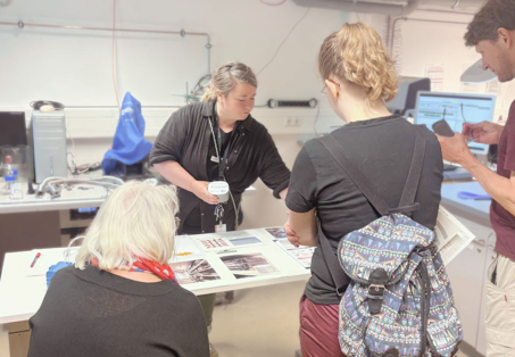
Festival der Zukunft (Festival of the Future)
4 July 2026, Deutsches Museum, Munich, Germany
Oral presentation: “Wie können uns Luftmessungen im Archiv Informationen über die Sammlung verraten?” (What can air measurements in the archive tell us about the collection?)
Presented by: M. Roth
Link to the event: https://www.deutsches-museum.de/festival-der-zukunft#c44036
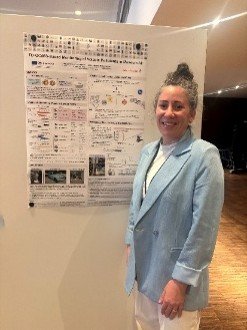
12th MaSC Workshop and Meeting
21–25 September 2026, Cologne, Germany
Poster: “TD-GC/MS-Based Monitoring of Volatile Pollutants in Museum Air: Method development,
sensor validation, and assessment of MOF-based sorbent materials within the SIMIACCI project”
Authors: M. Roth, A. Micheluz, L. Barchi, M. Pamplona
Link to the event: https://mascgroup.org/cologne-workshop-and-meeting-2026/
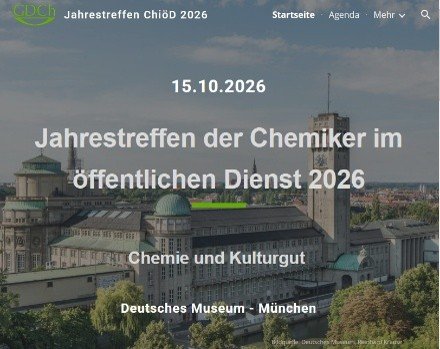
GDCh Annual Meeting of Chemists in the Public Service (Jahrestreffen Chemiker im Öffentlichen Dienst)
15 October 2026, Deutsches Museum, Munich, Germany
Oral presentation: “Historische Kunststoffe und ihre Zersetzungsprodukte: Materialanalytik und Raumluftüberwachung am Deutschen Museum” (Historic plastics and their degradation products: material analysis and indoor air monitoring at the Deutsches Museum)
Presented by: M. Pamplona, M. Roth
Link to the event: https://chioed2026.gdch.events/vortragende
Future events
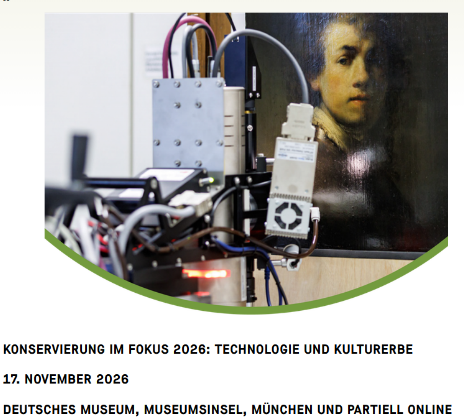
Konservierung im Fokus 2026: “Technologie und Kulturerbe” (Conservation in Focus 2026: Technology and Cultural Heritage)
Leibniz-Forschungsnetzwerk Konservierung und Restaurierung (Leibniz Research Network Conservation and Restoration)
17 November 2026, Deutsches Museum, Munich, Germany
Oral presentation: “TD-GC/MS-basiertes Monitoring flüchtiger Schadgase im Deutschen Museum: Methodenentwicklung und In-situ-Anwendung im Rahmen des EU-Projekts SIMIACCI” (TD-GC/MS-based monitoring of volatile pollutants at the Deutsches Museum: method development and in-situ application within the EU project SIMIACCI)
Authors: M. Roth, L. Barchi, A. Micheluz, M. Rovea, G. Giraldo, R. De Lorenzo, G. Formenton, M. Pamplona
Link to the event: https://www.leibniz-konservierung-restaurierung.de/mainnavigation/news/tagung-konservierung-im-fokus-2026-technologie-und-kulturerbe

 German
 English
 Portuguese
 Czech
 Dutch
 Danish
 Italian
 French